Ever since our own government’s WWI propaganda machine portrayed the Germans as evildoers intent on raping and pillaging the USA, Washington has managed to make the public fearful about one sort of impending doom or another. When I was a kid we were all going to be blown to smithereens by a Russian nuke. “DUCK and cover!” Then came the domino theory of communist takeovers. There were riots, crime sprees, gangsters, Russians, Communists, evil Birchers, Iraqis, Hezbollah, all out to doom the country.
Now looms the horrible cyberattack from God knows who.
Author Archives: mea
Deployment of Europe’s Galileo constellation continues
Galileo is Europe’s own global satellite navigation system. It will consist of 30 satellites and their associated ground infrastructure.
via ESA Portal – Deployment of Europe’s Galileo constellation continues.
The four satellites launched during the IOV phase are the nucleus of the constellation that will then be extended to reach its FOC.
NASA to Demonstrate Communications Via Laser Beam
It currently takes 90 minutes to transmit high-resolution images from Mars, but NASA would like to dramatically reduce that time to just minutes. A new optical communications system that NASA plans to demonstrate in 2016 will lead the way and even allow the streaming of high-definition video from distances beyond the Moon.
via NASA – NASA to Demonstrate Communications Via Laser Beam.
The LCRD is the next step in that direction, Israel said, likening the emerging capability to land-based fiber-optic systems, such as Verizon’s FiOS network. “In a sense, we’re moving FiOS to space.”
Why We Need a Supercomputer on the Moon
Ouliang Chang floated his lunar supercomputer idea a few weeks ago at a space conference in Pasadena, California. The plan is to bury a massive machine in a deep dark crater, on the side of the moon that’s facing away from Earth and all of its electromagnetic chatter. Nuclear-powered, it would process data for space missions and slingshot Earth’s Deep Space Network into a brand new moon-centric era.
via Why We Need a Supercomputer on the Moon | Wired Enterprise | Wired.com.
Clearly, the business of dreaming up supercomputers in space is not for those who think small.
Huawei and Cisco’s Source Code: Correcting the Record
Unlike the smartphone patent battles, where parties try to protect and grow their market share by suing each other over broad patents where no direct copying is required, let alone even knowledge that a patent exists, this litigation involved allegations by Cisco of direct, verbatim copying of our source code, to say nothing of our command line interface, our help screens, our copyrighted manuals and other elements of our products.
via Cisco Blog » Blog Archive » Huawei and Cisco’s Source Code: Correcting the Record.
Popular RATs Found Riddled With Bugs, Weak Crypto
The researchers, in conjunction with their research paper (PDF), released tools for decrypting RAT traffic and proof-of-concept exploits for the bugs they found. They found that the tools include weak, or no, encryption: Bandook, for example, uses obfuscation, not encryption, to protect its traffic between the victim’s machine and the C&C server.
via Popular RATs Found Riddled With Bugs, Weak Crypto – Dark Reading.
“A good understanding of their protocols is critical to network and system administrators deploying tools that can notice the presence of a RAT,” they said.
RAT = Remote Administrative Tool which is a tool used by the bad guys to snoop on a victim. To the victim this is more commonly referred to as a trojan.
TSMC Seen to be Sole 20nm Process Supplier
Taipei, Oct. 12, 2012 (CENS)–Citigroup Global Markets Inc. estimated Taiwan Semiconductor Manufacturing Co. (TSMC) to be the only supplier of 20nm process to Apple quad-core processors over the next one to two years, citing the company’s unmatched technological advance on 20nm process and Apple’s decision to adopt 20nm quad-core processors in its new products.
Lone packet cripples telco networks
Telcos the world over were running networks tantamount to “technology sandwiches” where layers of legacy kit had created such high complexity that operators were unaware of glaring holes which Langlois regularly revealed in penetration tests.
“We accessed [an operator’s] systems through their x25 network which they never knew was running because the network vendor never disclosed it — it was just underlying technology.”
Kii Cloud Opens Doors For Mobile Developer Platform With 25 Million End Users
MBaaS is more often a way to cater to developers. The idea here is that developers program the app and push it out to Kii Cloud without having to build their own servers and back end. At the crux of it, Kii sells simplicity and scale through the APIs and SDKs that use object database technology originally developed as an open source project by db4objects. Its ad network and distribution across Japan, Korea and China give it significant reach.
via Kii Cloud Opens Doors For Mobile Developer Platform With 25 Million End Users | TechCrunch.
MBaaS = Mobile back end as a service
From: Mobile Backend as a Service Roundup and the Future of Web APIs
To help me monitor the MBaaS market I spent some time rounding up as many of the providers as I could, and so far I’ve found 24 of them:
Ericsson Adapts to the TV Streaming Challenge
The problem with ABR is that the client device, such as a smartphone or tablet, is in charge of the bandwidth and isn’t fair about how that capacity is allocated. If an iPhone is the first device on the home network to request a video stream, it will typically receive a high bit-rate version — perhaps more than it really needs. Then, when a connected HD television requests a stream, it tends to get the scraps, resulting in a crummy-looking pixel-icious image.
Ericsson AB (Nasdaq: ERIC) is trying to solve the problem by applying Weighted Fair Queuing (WFQ), a data packet scheduling technique, to ABR streams.
From Wikipedia on WFQ:
WFQ is a generalization of fair queuing (FQ). Both in WFQ and FQ, each data flow has a separate FIFO queue. In FQ, with a link data rate of
, at any given time the
active data flows (the ones with non-empty queues) are serviced simultaneously, each at an average data rate of
. Since each data flow has its own queue, an ill-behaved flow (who has sent larger packets or more packets per second than the others since it became active) will only punish itself and not other sessions.
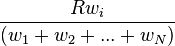
As opposed to FQ, WFQ allows different sessions to have different service shares. If
data flow number
will achieve an average data rate of
It can be proven [1] that when using a network with WFQ switches and a data flow that is leaky bucket constrained, an end-to-end delay bound can be guaranteed. By regulating the WFQ weights dynamically, WFQ can be utilized for controlling the quality of service, for example to achieve guaranteed data rate.